
Meet James West, LPC
I Love Stories

I’ve always been drawn to stories—especially the ones people tell about who they are, how they got here, and what they believe is possible for them.
Some of those stories help us make sense of our lives. Others become limiting without us realizing it.
I’m too much. I’m not enough. I’m bad at relationships. My partner doesn’t really understand me. There’s something wrong with my sexuality. This is just the way I am.
Therapy gives us a chance to get curious about those stories. Where did they come from? Which parts are still true? Which ones were shaped by shame, trauma, old relationships, or expectations that never really fit you in the first place?
Understanding your story doesn’t mean excusing everything that’s happened or everything you’ve done. It means knowing yourself well enough to have more choice about what happens next.
I’m James West, a Licensed Professional Counselor in Richardson, Texas. I specialize in sex therapy, couples counseling, and trauma therapy for adults who want to better understand themselves, improve their relationships, and build lives that feel more like their own.
You Shouldn’t Have to Edit Yourself in Therapy
Finding the right therapist can be surprisingly difficult, especially when the things you want to talk about are personal, complicated, or hard to explain.
Maybe you want to talk openly about sex without wondering whether your therapist is uncomfortable. Maybe you’re queer, neurodivergent, kinky, non-monogamous, or still figuring out what fits. Maybe you’ve spent a lot of your life feeling like other people don’t quite understand how your brain works, why you care so deeply about the things you love, or why certain situations affect you as strongly as they do.
Therapy shouldn’t require you to make yourself easier to understand before you walk through the door.

Accountability Without Shame
One of the ideas at the center of my work is that understanding yourself doesn’t mean excusing everything you do.
We all have reasons for the ways we react. You might shut down when conflict gets intense, become defensive when you feel criticized, avoid conversations you’re afraid will end badly, or promise things you have trouble following through on. Those patterns usually developed for a reason. Understanding that reason can help you respond differently, but it doesn’t mean the impact on the people you love disappears.
I want therapy to be a place where you can look honestly at what’s happening without turning that honesty into self-punishment.
That means learning how to take responsibility when you’ve hurt someone without collapsing into shame. It means recognizing the difference between accepting how your brain works and assuming you can never change. And it means developing expectations for yourself and your relationships that are challenging enough to matter without demanding perfection.
Your past helps explain your story. It doesn’t have to dictate the ending.
Therapy That Goes Beyond Knowing What You “Should” Do
Most of the people I work with are smart and insightful. Quite a few have already been to therapy. They’ve read the books, listened to the podcasts, learned the communication skills, and spent plenty of time thinking about why they are the way they are.
The problem isn’t always a lack of information.
You can know that you should communicate differently and still become defensive in the moment. You can understand your partner’s needs and still shut down when they express them. You can know there’s nothing shameful about sex and still feel anxiety, pressure, or embarrassment when you try to talk about what you want.
So our work usually happens on two levels.
We’ll develop practical tools for communicating more clearly, repairing conflict, setting boundaries, talking about sex, and making changes you can actually follow through on. We’ll also get curious about what keeps getting in the way of using those tools when they matter.
My approach includes IFS-informed parts work, trauma-informed therapy, EMDR when it’s a good fit, mindfulness, and other approaches depending on what you need. In sex therapy, I also draw from contemporary research on desire, arousal, sexual context, and the ways shame and relationship dynamics affect intimacy.
The goal isn’t simply more insight. It’s helping that insight become useful in your actual life.

Sex Is Something We Can Talk About Here
Sex is one of the most vulnerable parts of being human, and most of us received remarkably little useful education about it.
Instead, we picked up stories about what sex is supposed to look like, how often we’re supposed to want it, what our bodies should do, what our partners should intuitively know, and what it means when reality doesn’t match those expectations.
You don’t have to pretend those conversations aren’t awkward.
We can talk plainly about desire, mismatched libido, sexual anxiety, fantasies, pleasure, consent, performance concerns, shame, kink, sexual orientation, or the fear that you and your partner simply aren’t compatible. My job isn’t to hand you a definition of what a healthy sex life should look like. It’s to help you figure out what a satisfying and sustainable one looks like for you.

My Love Story
Couples counseling has been part of my own story too.
Being a client helped me understand how difficult it can be to sit across from someone you love and talk honestly about the ways you’ve hurt each other. Through therapy, my wife and I learned how to support one another more effectively while still honoring ourselves and our own pain. We learned how to take real accountability without dissolving into shame.
That experience shaped both the therapist I became and the name Love Stories Counseling.
I don’t believe a good relationship requires two people to become perfectly healed, endlessly patient versions of themselves. I think it requires people who are increasingly able to know themselves, communicate honestly, repair when things go badly, and remain accountable to one another.
Every relationship has a story. Therapy can give you a chance to understand the one you’ve been living and decide more intentionally what you want the next part to look like.
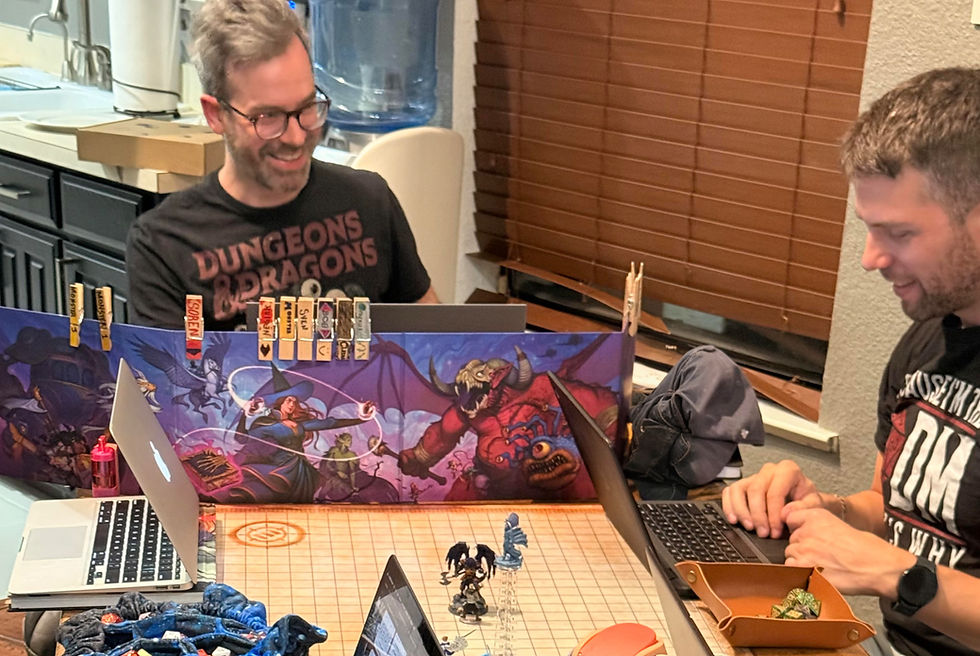
Yes, I’m a Pretty Big Nerd
Outside the therapy room, I’m a lifelong geek.
I’ve played Dungeons & Dragons since I was 13 and regularly DM games for friends. I love board games, video games, science fiction, fantasy, superheroes, and spending entirely reasonable amounts of time thinking about fictional worlds. Final Fantasy VIII remains my favorite video game, and Root is one of my favorite board games.
There’s probably a reason a person who loves stories this much became a Dungeon Master.
I’m also a musician and artist. Before becoming a therapist, I was involved in the Dallas arts community, producing workshops and mixed-media performances, and I released an album with my band in 2019. I still spend time making music and experimenting with audio production.
I mention this because interests like these matter.
A lot of the people I enjoy working with have something they care about intensely—games, art, technology, fandom, music, or a niche subject they know far too much about—and have spent years receiving the message that they should tone it down or grow out of it.
You don’t need to do that here.
Experience and Education
I began my counseling career in 2017 working in addiction and trauma recovery at an inpatient treatment center before moving into private practice in 2018.
I earned my Master of Science in Clinical Mental Health Counseling from the University of North Texas and my Bachelor of Arts in Psychology from the University of Dallas. Over the course of my career, I’ve developed particular experience working with sex and intimacy concerns, couples, trauma, LGBTQ+ clients, neurodivergent adults and relationships, and other therapists.
But credentials only tell you so much about whether someone is the right therapist for you.
You also need someone you can actually talk to.
I'd Love to Hear Your Story
You don’t need to know exactly what’s wrong, have the perfect words for what you’re experiencing, or know which kind of therapy you need before reaching out.
You can come in with the question you’ve been wrestling with, the conversation you and your partner keep avoiding, or simply the feeling that something in your life or relationship needs to change.
You already know the story that brought you this far. We can start there and figure out what you want to happen next.